Exosomes Production
Related Sections-Services
CD Bioparticles is a leading manufacturer and supplier of various drug delivery products, including exosomes for R&D and commercialization in a variety of application areas. CD Bioparticles offers a complete set of service for exosome isolation, characterization and engineering to facilitate exosome applications in biomedicines.
The Introduction to Exosomes
Exosomes are small endosome derived lipid nanoparticles (50-120 nm in diameter) secreted into extracellular space by most types of cells. Exosomal vesicles content includes lipids, genomic DNA, RNA, proteins. Many studies have shown cumulative evidence that exosomes have performed may biological functions particularly in cell-cell communication by providing means for intercellular exchange of proteins, lipids, mRNA, miRNA, and DNA. Its associated proteins and microRNAs that are closely related to the pathogenesis of most human diseases are invaluable biomarkers for disease diagnosis, prognosis, and therapy. Therefore, exosome isolation and characterization becomes crucial to understand its biological function and therapeutic application. The study of exosomes could be important for us to gain valuable information for early detection, disease monitoring and development of effective treatments against cancer and autoimmune diseases.
 Figure 1. Nanoparticles for delivery of bioactive particles and fillers.
More importantly, exosomes have been used as a promising carrier for therapeutic molecular delivery especially for cancer treatment due to its low immunogenicity, high biocompatibility, high drug delivery efficacy, and low cytotoxicity to normal tissue. Besides its natural targeting surface moieties, exosome could be engineered as needed to help its selective accumulation in cancer site. Exosomes has exhibited increased cytotoxicity and higher killing efficacy on cancer cells in recent studies.
Our Exosomes Production Featured Services
CD Bioparticles is specialized in the development of drug delivery systems and customizing exosomes for drug delivery utilizing our core technologies. With our high-quality products and services, the efficacy of your drug delivery can be tremendously improved.
We offer a whole set of service to improve the application of exosomes:
-
Isolation and Purification: Ultracentrifugation-based Isolation, Size-based Isolation, Immunoaffinity Capture-based isolation, etc.
-
Exosome Analysis and Characterization: Exosomal Lipidomics & Metabolomics Study, Exosomal Proteomics Study, Exosomal RNA Sequencing, etc.
-
Exosomes Labelling: Protein labeling, RNA labeling, Lipid labeling.
-
Exosomes Cargo Loading: Proteins, Nucleic acids (including mRNA, miRNA, lncRNA, DNA), Small molecules.
-
Exosomes Ligand Displaying: To target specific cell types.
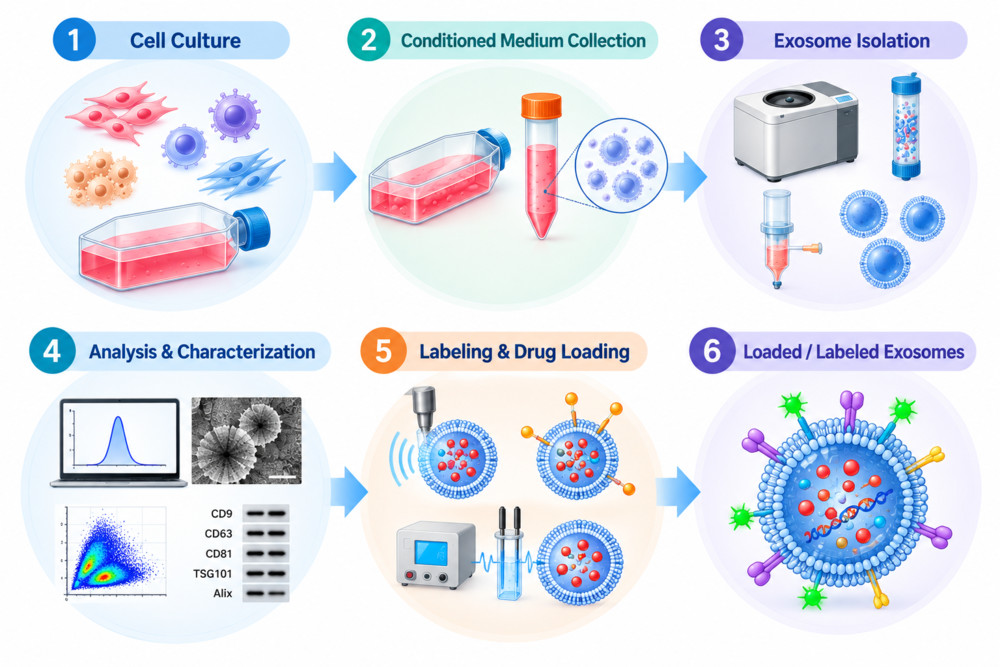
Exosome Production Process
1. Cell Culture
The production of exosomes begins with the selection and cultivation of appropriate parental cells. Common sources include mesenchymal stem cells, immune cells, epithelial cells, cancer cells, and other cell types. Cells are expanded under controlled culture conditions to maintain cell viability and promote consistent extracellular vesicle secretion. Depending on the intended application, physical, chemical, biological, or genetic stimulation may also be incorporated to modulate exosome production and potentially increase extracellular vesicle yield.
2. Culture Medium Collection
Following cell expansion and exosome production, the conditioned culture medium is collected because it contains secreted extracellular vesicles together with cells, cell debris, proteins, and other soluble components. The collected medium is generally subjected to appropriate pre-processing steps to remove intact cells and larger debris before downstream exosome isolation. Careful handling at this stage helps reduce unwanted contaminants and provides a more suitable starting material for purification.
3. Exosome Isolation
The pre-processed conditioned medium is then subjected to an isolation and purification process. Ultracentrifugation is a commonly used approach and can include differential or density-gradient centrifugation, where separation depends on factors such as particle size, density, and shape. Size-based separation can be achieved through ultrafiltration or size-exclusion chromatography, allowing extracellular vesicles to be separated from smaller soluble molecules or larger contaminants. Other approaches, including precipitation and chromatography-based methods, can also be selected according to sample characteristics, desired purity, processing scale, and downstream application.
4. Analysis & Characterization
After isolation, the resulting exosome preparation is characterized to evaluate its physical properties, concentration, morphology, and molecular identity. Particle size and size distribution can be assessed using techniques such as nanoparticle tracking analysis (NTA), while transmission electron microscopy (TEM) can provide information about vesicle morphology. Protein markers such as CD9, CD63, CD81, TSG101, and ALIX can be evaluated as part of exosome characterization. Additional biochemical, omics, nucleic acid, protein, lipid, surface-marker, and potency analyses may be incorporated depending on the intended research or drug-delivery application.
5. Labeling & Drug Loading
Purified exosomes can subsequently be engineered for tracking, functional modification, or therapeutic cargo delivery. For drug loading, the cargo may be introduced into isolated exosomes using direct loading approaches. Sonication temporarily perturbs the exosome membrane to facilitate cargo incorporation, while electroporation uses an electrical pulse to increase membrane permeability and promote the entry of nucleic acids or other cargoes. Co-incubation or passive incubation allows suitable molecules to interact with or diffuse into exosomes under controlled conditions. The appropriate strategy depends on the physicochemical properties of the cargo and the need to preserve exosome integrity and biological activity.
Quotations and Ordering

References:
1. You, Benshuai., et al. (2018) Engineering exosomes: a new direction for anticancer treatment. Am J Cancer Res. 8(8): 1332–1342.
2. Yim, Nambin., et al. (2016) Exosome engineering for efficient intracellular delivery of soluble proteins using optically reversible protein–protein interaction module. Nature Communications. DOI: 10.1038/ncomms12277.
3. Sterzenbach, Ulrich., et al. (2017) Engineered exosomes as vehicles for biologically active proteins. Mol Ther. 25(6):1269-1278.
4. Li, Pin., Kaslan, Melisa., et al. (2017) Progress in exosome isolation techniques. Theranostics. 2017; 7(3): 789–804.
5. Schageman, Jeoffrey., Zeringer, Emily., et al. (2013) The Complete Exosome Workflow Solution: From Isolation to Characterization of RNA Cargo. Biomed Res Int. 2013: 253957.
6. A Comprehensive View of the Characterisation of Exosomes. Sponsored by Wyatt Technology. Sep 25, 2018.

